Missy Williams & The Dania Beach Monkeys

If you’ve ever heard rumors about wild monkeys near the port and airport, this episode finally gives you the real story. Dr. Missy Williams pulls back the curtain on Dania’s vervet colony, from their escape decades ago to the modern sanctuary keeping them safe today.


Dr. Deborah “Missy” Williams joins Let’s Talk Lauderdale to share the incredible, very-Florida story of Dania Beach’s wild vervet monkey colony living on 160 acres of mangroves between Port Everglades and Fort Lauderdale airport. She explains their escape from a former biomedical facility, her creation of the Dania Beach Vervet Project and Monkey Sanctuary, and why these primates must be treated as wildlife—not pets.
- Hear the true origin story of Dania Beach’s vervet monkeys and their link to biomedical research.
- Get practical “wildlife etiquette” tips for encountering monkeys, raccoons, and other urban critters.
- Peek behind the scenes at an off‑grid sanctuary powered by solar panels and a 1,000‑gallon water tank.
- Discover how volunteers and students support daily care, enrichment, and field research.
- Find out how to donate, symbolically adopt a monkey, or become a Habitat Hero through
Links from the Show:
- Dania Beach Vervet Project & Monkey Sanctuary: https://vervetproject.org
- South Florida Wildlife Center: https://southfloridawildlifecenter.org
- Florida Atlantic University (FAU): https://www.fau.edu
- Broward College: https://www.broward.edu
- Chase Sanctuary: https://chasesanctuary.org
- LauderAle Brewery: https://www.lauderale.co
- Jungle Queen (Fort Lauderdale): https://www.junglequeen.com
- Fort Lauderdale Water Taxi: https://watertaxi.com
- Las Olas Boulevard (visitors site): https://lasolasboulevard.com
- The Florida Room: https://www.floridaroomftl.com/
- The Righteous Gemstones (TV series): https://www.imdb.com/title/tt8634332/
=== MUSIC LICENSE CERTIFICATE
- Title: Happy Epic And Confident Corporate Background Piece To Suit Health Or Dynamic
- Item ID: 195889930
- Publisher: Saowakhon Brown
- Composer: Saowakhon Brown
- License: Individual License, Commercial
- Stock Media provided by TheSaoLady / Pond5
Website: https://www.letstalklauderdale.com/
Let’s Talk Lauderdale is hosted by Marvin Bee & Jen Stewart.
Subscribe for more behind-the-scenes Lauderdale stories and pass this episode along—because every Fort Lauderdale memory deserves an audience.
Hello friends and welcome back to the Let's Talk Lauderdale podcast. The show where we talk about the people, places, and events happening huge and large here in the 954. Primarily for Lauderdale, but we always talk about the greater South Florida area.
I'm Marv. And I'm Jen. And we are here with a very special show.
I'm so excited. And we took a little page out of something we talked about a couple of weeks ago. The Vervet Monkeys.
Yes, I can't wait. I can't wait to dive in. Why are you whispering? I don't know.
Am I? Okay, I'll yell. We have a guest here. You're trying to be nice.
Behave. Don't behave on my bed. Okay.
That third voice that you heard is Dr. Deborah Missy Williams. And she is a South Florida primatologist. And you head up the Vervet Monkey Project that we were talking about.
Yes, yes. I'm the director and founder of the Danube Beach Vervet Project and also Monkey Sanctuary. I opened the facility in August of 2022.
And that's when we got our first resident, Spock. Spock. So how did you find Spock? How did this happen? Spock's story is a bit dramatic.
So the wild monkeys that we do have here in Danube Beach, people love to feed them. And they have fed them historically for since the 40s or 50s based on research that I've done. So they're used to people, see them as a food source.
And from what I was told, the monkeys were showing up at a warehouse near the port. And they were feeding the monkeys, and particularly Spock. And he kept coming back every day.
And then I guess the warehouse worker decided to feed him inside the warehouse as opposed to outside. That upset a few employees. They were worried for their safety, which I understood.
So they trapped them. And this was in 2019. As a non-native, you can't release the monkey at all.
So the options were either to be euthanized or to go to a person with a Class 2 permit, which is what you need from Fish and Wildlife to have one of these monkeys. Typically, most people with a Class 2 participate in the pet trade. And this is what happened to Spock.
Spock ended up with a pet dealer. And I only found out about it because one of the warehouse workers, upset, told his wife. And his wife tracked me down and called me and told me about Spock.
So I had to work out a way to get Spock back from the pet dealer in Miami. Eventually got him back. So many questions there.
Let's first start with, who was it that trapped Spock? Was it, though, the people at the warehouse? Or did they hire somebody? I'm not sure. Someone told me that they trapped him once and drove him away and let him go. And then he came back, which they're good.
They know where they're going to go. Homing devices built in. And then I think they might have called someone who had the ability to trap officially.
And they used that person. That's what I believe. The story's a little murky.
But he's safe. That's all that matters. Now, let's kind of define where we're talking about.
Because you're here by the port. And that can mean a lot of things. As I'm not a native, but I've been in Lauderdale long enough to know that there's a whole lot of open land around the airport and the port.
So what type of area are we exactly talking about? So the monkeys reside in the 160 acres of mangrove space left between Port Everglades and the Fort Lauderdale airport. So it's a strip of land that runs north to south. East of US-1? Yes.
East of US-1, just west of the port, right? I'm thinking there's off Eisenhower, there's a long strip of land. It's off of Eller Drive and then Northeast 7th Avenue are some of the connecting streets, if you look up on a map. But the whole area is all mangrove space.
And that's where they hang out. Okay. Can I ask a question? Go right ahead.
Where did the monkeys, how did they start living there? They're non-native. Non-native. Where did they come from? This is such a Florida story.
I feel like this whole thing is just Florida all over it. I was doing my research and I was like, how do monkeys from Africa end up in Danube Beach just roaming freely? That's just wild to me. I'm from California, so I didn't really understand how Florida was.
Now I get it. So I think if I was a Florida native, you'd be like, oh yeah, there's monkeys. I wouldn't think twice about it.
But this was weird to me. So I started doing my research and it turns out there was a place called the Anthropoid Ape Research Foundation. And it was opened by Layla Roosevelt, who I believe was a cousin to President Roosevelt, and her partner, Armand Dennis.
They were importing animals in from Africa to be used for the biomedical trade. And the vervet monkeys were part of that. So they were trapped, brought in, and kept at the Anthropoid Ape Research Foundation.
So they were biomedical. So they were doing testing. They would sell them off to different facilities.
From what I understand, the vervet monkeys were actually part of the development of the polio vaccine. Oh, wow. So thank you to the vervet monkeys who participated in that.
Okay. That's interesting. And so then they just escaped one day? The Ash family bought the Anthropoid Ape Research Foundation, I believe in 1951.
And it became the Dania Chimpanzee Farm. If you Google the Dania Chimpanzee Farm, you'll see some really semi-creepy images of a crochet chimpanzee out from the entrance. But I was told from one of the employees, he's no longer alive, that either the zookeeper forgot to latch the lock or the monkeys opened the lock.
It was so simple. You know the spring when you pull back and lift up? Right. That's easy peasy for a monkey.
Yeah. So I think they waited until everyone left. And they're like, hey, guys, we're going to bust out of this joint tonight.
Let's go. And that's what happened. And that was it.
Yeah. They got all of them back, but 12 to 15. So the 12 to 15, the 12 to 15 monkeys that managed to stay out in the mangroves are the descendants of the, we had the 36 or 40 today? Yeah.
So that's where they all came from. So again, growing up down here, I've heard several different stories. So I'm glad to have the real story of one of these monkeys.
Yeah. People always talk about Hurricane Andrew. That's what I've known.
No, definitely. Yeah. This predates that by years.
Okay. Yeah. That's the story I was told.
Interesting. So let's do a quick sidebar because you said you're not from here. You came from California.
Yes. When did you first arrive in South Florida? I moved here in the summer of 2000 and I'm trying to think, 2007. Okay.
Yeah. And you came by choice, I assume. This is a funny story.
I lived in Orange County, California, and my husband was from Fort Lauderdale and we met in Las Vegas. A random encounter. Meant to be.
And here I am. Yes. I have never intended to move to Florida at all.
Here I am. Okay. 2007.
Almost a native. Yeah. Could be.
Yeah. I'm getting there. I'm trying to figure out how a Fort Lauderdale dude met a gal in Vegas and convinced her to go to Fort Lauderdale.
Not vice versa. He was there for a bachelor party. Okay.
And I was there with my sister and we just happened to meet at the Hard Rock Cafe, the Circle Bar, and there I am. Yeah, there I am. Life is weird.
Yeah. Wow. So when did your route to become a doctor start? Oh boy.
Always wanted to go back to get my doctorate. I just knew that the work behind it was intensive and I don't think the timing was right for me. But once I moved here, I started teaching at Broward College and I had a master's in anthropology and I really wanted to secure a full-time spot as a professor.
And the trend was that they were hiring PhDs. So I thought, I'll go get my PhD so I can get a full-time college or university spot. And that's how I ended up going back to get my PhD.
Okay. That was FAU? Yes. Okay.
I went to FAU for that, integrative biology. Yep. No intention of opening a monkey sanctuary, so.
I feel like my whole story is just odds and ends, chance encounters, chance meetings. And I feel like that's how it works though. Like we're meant to meet certain people at certain times.
I agree. It's very serendipitous. Yes.
We all have those stories. I mean, Jen, your original, your origin story is very interesting. I was born in Cleveland, but a few mishaps brought us down to Florida when I was very young.
Oh wow. See, I think that happens to everyone, right? Pretty much, yeah. I took a job out of grad school in Fort Lauderdale.
Yep. And then decided, yeah, I'm good. I'm not moving anymore.
Yeah. Yeah, you're done. Yep.
Yeah. Here we all are now. Here we are.
Yep. So now back to the monkeys, because that is, of course, the thing we talk about. So let's first start with the fact that they're primates, not pets.
Right. Because, I mean, one of those stories was that, you know, just like the pythons, everybody thought, well, people probably brought them over as pets and then they got loose. But that's not the case here.
No. But since they're out in the wild, if somebody were to come across one, what are the, what's the proper etiquette that we should take with them? Yes, I'd like to talk about wildlife etiquette. So I think because of development, we've kind of lost our connection with nature.
And now people, I think when they see what they consider wildlife, which I consider, you know, urban critters like coyotes, fox, raccoons, opossums, they've all been part of the urban ecology. However, I think now that we're developing more and more and we're having this overlap with human wildlife conflict, it really isn't conflict. I don't think it is.
It's just like, oh my God, now there's a raccoon in my yard. Right. So always tell people when you see a wild monkey, it's a wild monkey.
It's not a pet. They may look cute on Instagram or whatever nonsense you watch, but they should be respected as a wild animal. Don't try to approach them.
Don't try to touch them. Just take pictures. Enjoy it.
Because where else in the United States can you go and just see a wild monkey show up? You can't. So enjoy it while you can, right? And respect the experience. And it's hard to get that message across, I think, to people.
Ginny and Dana, do you hear people talking about just, there's a trail, right? Isn't there some trails by the airport that people can run and jog and come across the monkey? I'm not so sure about that. But I've heard people talk about the monkeys, and I've heard people doing probably what they shouldn't be doing is feeding the monkeys. Oh, that's, yeah, like I said, it's been going, it's illegal in the state of Florida to feed, but people still feed it.
Right, right, right. Just the law that's unenforceable, I think. Right, right.
And I think the sea turtle population, like the people that protect the sea turtles, have that same issue. You're not supposed to touch a sea turtle. There's a lot of rules.
I think people just don't know. And they think they're helping. Well, people get upset when they turn off the lights.
Well, that's a whole different show, and that's a problem. Oh, turn off the lights. I thought you meant turn on.
No, turn off for the turtles. People get upset about that. Yes.
It's an inconvenience, I'm assuming. Of course. Yes.
This is the other issue. Wildlife becomes an inconvenience. Exactly.
They share the same space. They were here before us. Yes, I always argue that.
You share the same space, you just gotta work it out and do it in a nice way. Exactly. Sorry, all I can think of, you mentioned raccoons.
And raccoons are an issue at my house. They swim in our pool. And they play on our roof at night.
And it's one of those things where the wife sometimes is like, why do we have this issue? And I'm like, well, first of all, you feed the cats. Free food. So they know the food is here.
And it's a game now to see how fast you can feed the cats, bring the bowls in before the raccoons show up. And they watch. Raccoons are so clever.
So we have raccoons out at the monkey site. And we have to keep all of our doors shut because if not, they'll wait till you're not looking and go in to try to rob you. Oh, they're smart.
Yeah. And I actually tripped over one when he was running out and I was going into the monkey office. I was like, what is happening here? And I'm like, oh, five-finger discount.
I see what's happening. And he probably didn't even move. He's like.
Do the monkeys and the raccoons coexist? Like, is everything? Yeah, it's interesting back there. I think, you know, all of my volunteers and I practice something called compassionate conservation. If we don't disturb the wildlife, every animal deserves to live.
Every animal life has value. So we just let them show up and they do their thing. So we've developed, I think, a respectable relationship with wildlife out there.
They know that we're not going to hurt them. They aren't going to hurt us. So we all managed to coexist peacefully.
Right. I think, you know, I wish people could do that outside of us. Yeah.
Yeah. Absolutely. And it can be done.
I think it's just people just don't have the knowledge or the understanding of what that looks like. Exactly. Yeah.
Exactly. So in terms of the project, what is actually the overriding goal? Because it sounds like it started out as protection. Yes.
But I'm assuming you had to add education in there. Yes. So what else has been added to the project? So yes, it's taken a lot of twists and turns and a lot of adaptations over time.
Originally, it opened just to help the wild monkeys only. I was like, I'm going to open a sanctuary because during my research, I saw animals that were injured and nobody would help them. That's not fair just because they're non-native.
So I'm like, all right, I'm going to open a sanctuary for that specifically and let people, the community know, like, these are wild monkeys. This is how you should act around them. Where do they come from? And to encourage people really just to leave them alone.
And that's a protective measure as well. However, as soon as people found out that I had a permit to take vervet monkeys, then all of a sudden people were like, hey, can you take my pet monkey? So now, unplanned, I am home to six surrendered pet monkeys. So that was never part of... A hundred? Six.
Oh, surrendered. Oh, 600. No, no, no, no.
Oh, no, no. My husband would divorce me. Okay.
But six surrendered... Yeah, they're surrendered pet monkeys. So, yeah. So that was not... Not in the plan? Nope.
It was not on the plan. I didn't even think about pet monkeys. I knew it was an issue, but I didn't think that I'd be involved in helping some of those animals.
Right, right. So what does it look like? Is there... What does your campus, I guess, look like? Are they in cages? Are they roaming free? So the wild monkeys visit us all the time. Okay.
So that is fine. We enjoy their company. And they do like to antagonize the ones that are inside the enclosures.
Okay. That's always interesting to watch. It's them, like, you're in a cage.
Yeah, yeah. We have one monkey. His name is Baby Billy.
So every season, we pick a series, a TV series or a movie, to name the infants that are born. So we can remember, like, oh, you know, that's Rooster. That was Top Gun year.
And that was 2020. And so we have one called Baby Billy from the Righteous Gemstones. I don't know if you all have seen that.
It's a ridiculous series with Danny McBride and Will Goggins, the actor. I love them to death. So that is my side note.
But we have one named Baby Billy, and he was electrocuted. We could never trap him, but he self-amputated his own arm. But we think, based on his really bizarre behavior, that he might have suffered some possible brain damage.
And he likes to come around and just go up and down the enclosures, starts at the top, and then, you know, tries to pick fights at the top. And then he'll literally start down here at this, on the bottom, and run through. And he sticks his little chicken wing through there like a shiv, trying to antagonize and upset the monkey.
It's a little bully. Yes. Yeah.
Wow. Yeah. So that's one of the wild monkeys that comes through.
Okay. Yeah. And we always, Baby Billy! You hear volunteers, just like, because, you know, he's up to no good.
So, yep. So the wild monkeys are there. And then, obviously, we have 1,200 square feet of enclosures for the monkeys.
Yeah. That's where we, yeah, we have, they're divided into four groups. So monkeys like to live in social groups.
So we have four different social groups divided amongst that 1,200-foot enclosure. Right. Right.
Okay. Yeah. Do they roam outside of that area? Or do they pretty much stay in that sanctuary area? They stay pretty close to us.
Yeah. So. They know where the food is, right? Yeah.
And it's their little, it's for their little home bases anyway. So they typically don't go far from that, you know, not unless they're looking for food, but because people feed them all the time, there really isn't a need for them to wander too far away. Right.
Yeah. So monkeys are not pets. No, no, no, no, no, no.
They are not pets. But how does one get a pet monkey? It, so the laws are different from state to state. Some prohibit it outright.
And then some, you can get a permit like we have in the state of Florida and you can buy them. You should buy them. You're supposed to buy them from a USDA registered breeder.
But the black market is insane for the exotic pet trade. So we picked up one last year from Fish and Wildlife who was confiscated because they had this monkey illegally. So this happens.
You hear this story all the time. People keep them illegally. So it's just, it's impossible to keep track of the breeding.
And selling and that sort of thing. Actually, I was at an event not too long ago. And there was a woman there with her pet monkey.
And you can tell this monkey was afraid. I mean, because anytime anybody tried to go up and see it and talk to it, it was just lashing out. And it was screaming.
And it's like, this poor thing does not want to be here. Just read the signs. Yeah, they're not domesticated.
So they get stressed out easily by the attention. And I don't know if the owners think that's normal, which is a problem because that's not normal behavior. It's a detriment to the animal.
Or they're just like, okay, well, the animal gets stressed, but we're going to leave anyway. I'm not sure which it is. So I heard you talk about volunteers.
Yes. What does it take to run that sanctuary in terms of manpower, people power, money? I mean, I'm sure it can't be cheap. It is not.
So you have to have a good sense of humor and some flexibility and lots of coffee. So that is the big thing. And then a love for animals, obviously.
It is primarily self-funded through my husband and me. It's difficult to get donations, especially, I think in the state of Florida, non-native species have been targeted as being bad, so to speak. So getting donations to support a group that helps a non-native is very difficult. So we do get donations from time to time from people who have lived in the community and grew up with the monkeys and they love the monkeys.
So they're happy to see what we're doing. But now that we have eight monkeys that require care, we have volunteers that come in in the morning and then come in in the evening. So they get fed twice a day.
The enclosures are cleaned, enrichment's provided, toys are switched out. So it's a lot of work. Yeah, it's a lot.
And we don't have electricity or water out there. So we had to create solar power. So we have solar panels that run across some of the enclosures.
And that allows us to have light. We have solar-powered A.C. And then we have a thousand-gallon water storage tank. And we have a pump for that to get it into the office so we can clean our dishes.
Oh, so you had to build the whole infrastructure for that area. Yes. Yeah, it took a lot.
Yeah. Yeah. Like I said, originally, we just thought I'd just have a wild monkey.
And if I would have stayed on that and said, I don't want to take pet monkeys, I'd just only have two. Right. We would have had Betty and Spock, and that's the end of it.
Because we've picked up other wild monkeys over the years from injuries, but they pass away. Right. So in my mind, it was always going to stay like a small little spot, and then here I am.
So there you go. There's nowhere else. It breaks my heart that there's other non-native.
So I assume there's a donation button on your website? Yeah. So burvetproject.org. Yep. I'm going to have the link in the show notes and encourage you, if you're listening, to at the very least donate.
Yes, that would be wonderful. I think you and I should take a trip out there. I think we should.
Yeah, you'll come see. Probably not much to do a tour of, but at least to see it. To get your eyes on it.
I think when people come to see it, they're like, oh god, now I get it. We're not open to the public. Right.
And it's because the six former pets, when they see strangers, like you mentioned, their reactions are very, very negative. So to keep them from being stressed out, we only have familiar faces, which are volunteers, you know? Do you work with students from any of the local universities? Or who are your volunteers? Are these people that just have a love for animals? Yes, it's a love for animals. And a lot of the volunteers came from the South Florida Wildlife Center.
Okay. I wanted to make sure that they were comfortable working with wildlife in the first place, because primates are next level. When working with exotic animals, they can be very dangerous.
Right. And people don't realize it. Like, they look cute, you know? People hug them on Instagram.
I'm like, no, no, no, that's not how it works out. They want to eat your face. I promise you that.
They're strong, right? Oh, yeah, 100%. Yeah. So that's a big thing, too, that people have a background working with the exotic set.
And we do have a student from FAU. She's a master's student named Jayla Perry. And she's actually studying the wild monkeys.
So she's looking at the vocalizations to see if they've made any changes in a novel ecosystem, or if they've created their own calls. So I can't wait to get that data out from her. So it's really interesting to see what she's going to find.
So we're looking for that. And we're looking to open a field school, too. That's the big thing moving forward, to provide a space.
I think science should be accessible for everyone. And I think students who want to get hands-on field experience, you know, they typically have to leave the country. And it's so expensive permitting.
So I want to be able to provide a space that's affordable for everybody. So that's something we're looking to do in the future. That was actually one of my questions.
What do you see in the future? What's, you know, growth or project-wise? Yeah, that's the big thing. Yeah, we're offering a free pilot ecology field class next month. Well, actually, no, no, it's not next month.
It's December. Here we are. Surprise.
Yeah, next up. Yeah, so we're doing a pilot class. It's three days.
And Aaron Mencia, who's also a graduate student at FAU, is running it. He has great field experience. And we're just looking for students to join and give us feedback.
Like, this worked out well, this didn't. That way we can move forward with some really strong curriculum. Right, right.
Yeah, so we're excited about that. Yeah, it sounds great. 160 acres.
It's a living laboratory and should be used for that. It's amazing. Absolutely.
We have it right here. Yeah, better than being developed. Yes, absolutely.
So let's do another side question. Sure. What do you do for fun? I mean, there's, you know, South Florida here.
There's, you know, what do you do for fun when people come to visit you from out of town? So. The place that you take them. Yeah, we were just talking about this before we started the show.
So you'd mentioned Jungle Queen. I haven't done that yet. But we do like to recommend the water taxi.
And especially now, I know the water taxi does like a Christmas. Holiday lights. Yeah, I love that.
And you can get cocktails. So that's right up my alley. I did that last year.
I highly recommend it. It's great. Yeah, we love that.
We do that. And then we like to go to Las Olas. Like a lot of new restaurants that pop up.
We like to take guests down there. And what else do we do with them? I feel like our social life is motivated around food. Now that we're thinking about it.
We're buddies, Nan. I was going to ask you what's your favorite restaurant down here. Paddleboarding, I don't want to be.
No. No, I hear about, I don't know if this is true, but I hear that there's bull sharks maybe in there. Pelican.
I haven't seen them, but I've heard. See, and I do not want to be like this. The one person who tried it once and I'm on the channel six news is a victim.
I was like, no, thank you. Yeah. So we don't participate in those types of activities.
But yeah, we're food, we're food motivated. You have a friend here. Yes.
Yeah. So we'd like to do all the restaurants. Yes.
Yeah. Like craft cocktails. I've heard the Florida room at the Fort is amazing.
I have not been there yet. No. So yeah, brand new one.
Okay. Yeah. We'll have to add that to the list.
Yes. Yeah. Yeah.
We do like going to the different breweries too. That's one of the things we enjoy doing too. So like a Lotter Ale over by the airport.
I love Lotter Ale. And the monkeys show up there. And the monkeys all show up there.
Yes. So you can have a beer and maybe the monkeys maybe show up. Okay.
Yeah. Yeah. We love them.
Yeah. The owner built, Kyle who owns Lotter Ale actually built one of our enclosures for us. Oh, really? Yeah.
Okay. Yeah. Very nice people.
Yeah. Lotter Ale invasive species. Yes.
Yes. Yeah. So yeah, we'd like to do all the local hunts like that when folks come to town.
Yeah. I like to find the local spots. Yeah.
Well, that's what I was going to ask you about was the restaurants. I took Jen's thunder. Where do you like to feed? Oh, where do you like to feed? Yes.
Yes. Yes. All right.
So, you know, we talked about it a little bit. You know, you started out in Cali, met the man from Fort Lauderdale. You're here.
It sounds like you're going to be here quite a while. Is this the last stop? This is. You know, monkeys live 20 to 25 years and my husband pointed this out to me.
So what he's saying is that's your retirement time? Yes. It was all, he's like, you know, you're going to be 70. These monkeys are still going to be alive.
What's your game plan? Is there a succession plan going on? I'm trying to get Aaron involved and take over. But I think he sees the trials and tribulations. He's like, I'm going to watch from the side for a little bit, see how that goes.
We did buy some property in North Carolina. Okay. So.
As most Floridians do. Yes, I know. So predictable.
Yeah, and we have acreage. And so if push comes to shove and we have to move, we have a spot to take them with us. So I'd love to take the wild monkeys.
Okay. But that's a whole other. Yeah.
How would you even begin to do that? It's a lot. So, yeah. So they, I feel like they should be in a safe place because people that I've seen over the years do some crazy stuff that they shouldn't be doing with the monkeys.
But it's like a conflict. They're part of the culture here. Dania Beach loves them.
Right. You know, people enjoy seeing them. But the backstory of what goes on behind with these wild monkeys, like, oh, not so much, you know, we don't talk about that.
We probably should. But so, yeah, maybe we'll have enough space to take all of them. I don't know.
My husband would definitely divorce me then. Sure. The monkey.
Roll up with like 40 monkeys. Like, what is this? I don't know. I just found them.
I left them on my porch. How would they do in North Carolina, though? I mean, would they need the hot weather down here? Well, yeah, I'm already thinking. I went right to chat GPT and I was like, hey, how can I create a warm housing for the monkeys? And some of the places up in North Florida, they experience the cold.
So they actually use almost like those sheds are already put together and they get the smaller ones and then they insulate them and they have little heaters. Like a little greenery type shed. Yeah, yeah.
And they have, you know, like the heater comes on, they can go in and hang out and it's waterproof, windproof, weatherproof. You've thought this through? Oh, I'm ready. So, yeah.
But it requires, once again, money. Yes. But yeah, so if we had to take the eight that we have, that's what we would do.
Provide, you know, a nice, warm, cozy weather shelter. They go out during the day, you know, and then they could go back inside when they got cold. So it'd be nice to have that option for them.
So, but that's way down the road. Okay. Is there anybody else in this community or anywhere doing the work that you're doing? Not that I know of.
There are other sanctuaries that are open. However, I think we're the only ones that cater to... For vet monkeys. I know Chase Sanctuary, we've worked together.
So they have two vervet monkeys. One came from the wild, Ninja Joe. And then she has a pet.
So I think, based on the people that I've talked with, she's the only one that has vervet monkeys. Okay. Yeah.
Yeah. So I feel like... Else we can do to support you? I mean, money's key. I work in the non-profit world.
I know that's tough. Yeah. Is there anything else supply-wise, food-wise, partnership-wise? Looking for? On vervetproject.org, we actually have different programs that people can contribute.
Like a produce partner would be great. We have Habitat Hero Program. You donate; it helps expand habitats.
You can adopt a monkey symbolically. So out of the eight, you want to symbolically adopt Mojo. So that's available on the website.
So we do have merchandise on there. So it's always a fun way to get some merch to wear out in town and at the same time, give back to the monkeys. Okay.
Yeah. Great. Great.
We will help promote that. Yeah. And I guess we'll have to coordinate the visit.
We can't just show up. Yeah. No.
Yeah. Yeah. It's like we're back in the mangroves.
You have to go through a security gate to get even to on the lot. And then you have to get back to us. So it's an over the hills.
Oh, that's good. That's good. It's a journey.
It should be. Yeah. Yeah.
Because I've been back in that area, but I had no idea where you were. Yeah. It's hard.
Yeah. Yeah. So we'd like to keep a little private, but people post on social media and I'm like, what are you going to do? Right.
I have no control over that. Yeah. All right.
Well, Missy, thank you very much for, first of all, thank you for coming in studio to do this. Of course. It's so much better to talk face to face and share stories.
I agree. But thank you for sharing the history of the Vervet project and your involvement. And we will do what we can to help you along.
I appreciate it. No, thanks for being here. Yeah.
Thank you all. All right. Thank you folks for tuning in.
And that is going to do it for this episode of the Let's Talk Lauderdale project. I see now you get. We have our project.
Let's be real. We are a project. That is it for the Let's Talk Lauderdale podcast.
Be sure to check us out on our website and on the social media. We've got the Facebook page that we are maintaining and hoping to get some friends to join us and help us find other people to interview and find out about all these great places that we should know about as Floridians and help. Sounds good.
All right. I'm looking at you. I'm thinking you're going to interject something here.
Oh, no, no, no. I'm quiet this morning. All right.
Celsius to kick in. But that's it, folks. Thank you very much.
We'll be back soon with another episode. And we'll see you then. See ya.
Bye. Bye.
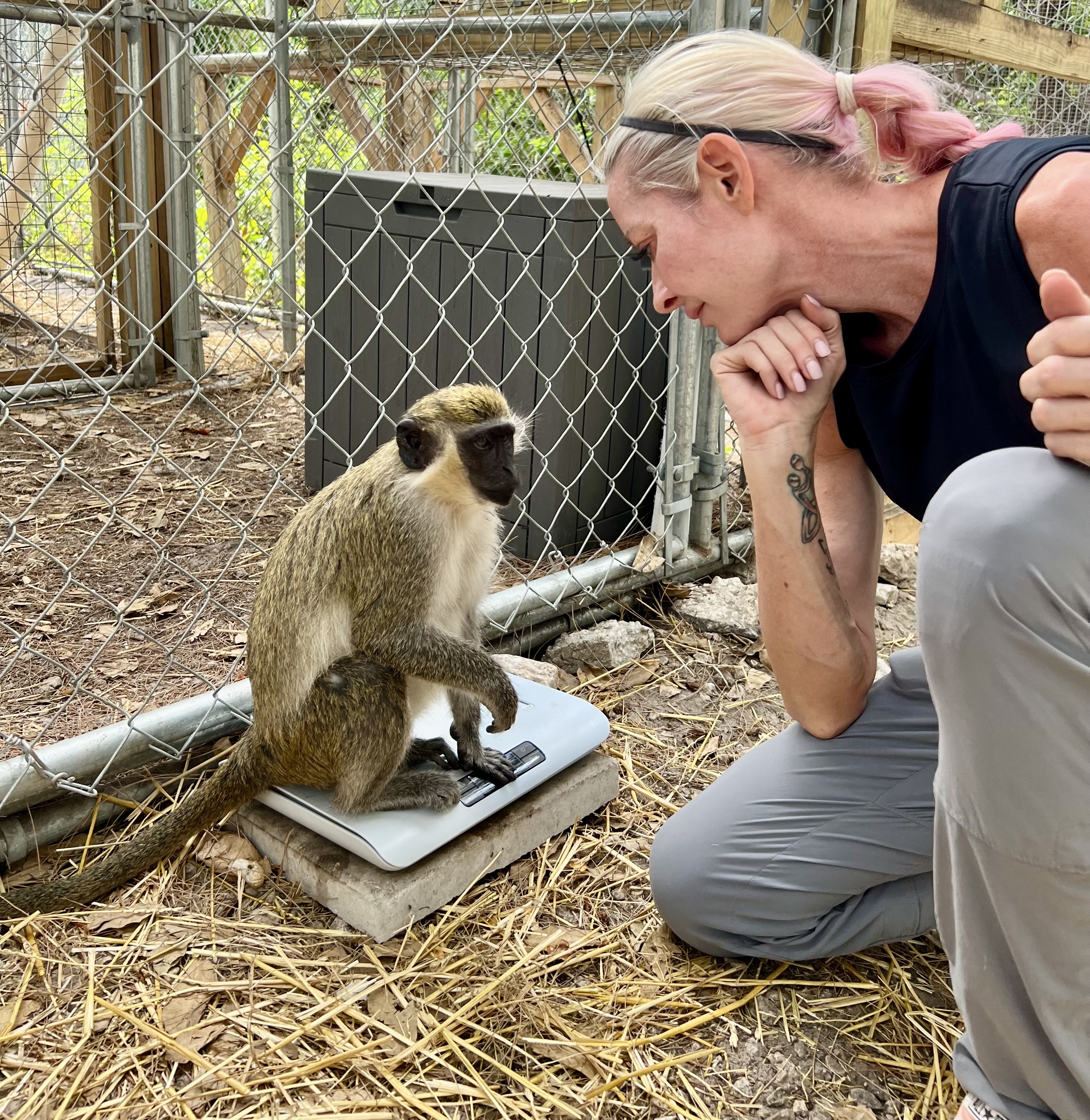
Scientist/ Monkey welfare advocate/ Compassionate conservationist/Primate sanctuary director/Professor/Mom
Dr. Missy Williams is a primatologist, educator, and advocate for compassionate conservation. She founded the Dania Beach Monkey Sanctuary to protect and study South Florida’s wild vervet monkeys while caring for individuals who cannot live freely. Dr. Williams earned her Ph.D. in Integrative Biology from Florida Atlantic University. She is deeply committed to fostering community engagement and promoting peaceful coexistence between people and wildlife, encouraging residents to appreciate and protect ecosystems. Under her leadership, the sanctuary has become a model of ethical wildlife care. Through outreach and education, she inspires respect for the intelligent animals who share our world.