Fort Lauderdale Luxury Closets with Donna


Fort Lauderdale realtor and business owner Donna Zalter joins me in studio to share how she went from selling high-end condos to fixing the messy closets inside them with her company All Hung Up Hangers. We talk Broward living, walkable neighborhoods, local culture and what it really takes to run a small product business from Las Olas and Pompano.


If you’ve ever looked at your jam‑packed closet and thought “too many clothes, nothing to wear,” this one is for you. In the studio with me is Fort Lauderdale luxury realtor and hanger founder Donna Zalter, who saw messy closets in million‑dollar South Florida properties and decided to tackle the problem starting with the hanger. We talk real estate cycles, e‑commerce reality, AI, and why All Hung Up Hangers is built from the ground up right here in Broward.
- Originally from Montreal, Donna has lived in South Florida for about 35 years, starting in Hallandale/Hollywood and eventually moving to Fort Lauderdale to get closer to Pine Crest School and out of I‑95 traffic.
- Donna loves Fort Lauderdale’s walkability, calling it a small city that feels like Buckhead in Atlanta, with new, shiny growth but still manageable size.
- Donna shares what her real estate business coach is telling agents: you must be “AI searchable” now, whether you’re in real estate, IT or selling hangers.
- Check out AllHungUpHangers.com for Donna’s curated hanger line and grab the limited-time 15% off discount.
Chapters
- 00:23 Welcome to Let's Talk Lauderdale
- 02:03 Entering Real Estate
- 03:28 The Market Shift
- 06:02 The Closet Dilemma
- 06:09 Hangers and Home Style
- 19:50 Business Life in Fort Lauderdale
- 26:07 Community and Culture
- 31:26 Launching All Hung Up
- 36:03 Embracing AI and E-commerce
Guest: Donna Zalter,
- All Hung Up Hangers: https://allhunguphangers.com
- Donna Zalter: https://www.linkedin.com/in/donnazalter/
People, Places and Events Mentioned
- Pine Crest School: https://www.pinecrest.edu
- The Container Store: https://www.containerstore.com
- Dolores Catania: https://www.instagram.com/dolorescatania
- Las Olas Boulevard: https://www.lasolasboulevard.com
- Flagler Village: https://www.flaglervillage.org
- FAT Village Arts District: https://fatvillage.com
- Riverfront (downtown Fort Lauderdale area): https://www.goriverwalk.com
- Galleria Mall Fort Lauderdale: https://www.galleriamall-fl.com
- Broward Center for the Performing Arts: https://www.browardcenter.org
- Museum of Discovery and Science: https://mods.org
- Buckhead (Atlanta): https://www.livablebuckhead.com
- Sway Nightclub: https://swaynightclub.com
- Dicey Riley’s: https://www.facebook.com/diceyrileyspub
- The Wharf Fort Lauderdale: https://wharfftl.com
- A1A Fort Lauderdale Beach: https://www.myfortlauderdalebeach.com
- S3 Restaurant: https://s3restaurant.com
- Steak954: https://steak954.com/
- Lululemon: https://shop.lululemon.com
=== MUSIC LICENSE CERTIFICATE
- Title: Happy Epic And Confident Corporate Background Piece To Suit Health Or Dynamic
- Item ID: 195889930
- Publisher: Saowakhon Brown
- Composer: Saowakhon Brown
- License: Individual License, Commercial
- Stock Media provided by TheSaoLady / Pond5
Website: https://www.letstalklauderdale.com/
Let’s Talk Lauderdale is hosted by Marvin Bee & Jen Stewart.
Subscribe for more behind-the-scenes Lauderdale stories and pass this episode along—because every Fort Lauderdale memory deserves an audience.
[0:11] Hello, friends, and welcome back to Let's Talk Lauderdale, the show where we shine a light on the people and ideas that make the greater Fort Lauderdale
[0:20] area just a little bit better, one story at a time. I'm your host, Marv, and today we are opening the closet doors, literally.
[0:29] If you've ever stared at a packed closet in your house thinking I have way too many clothes and somehow nothing to wear, this episode is for you. My guest saw that same problem over and over again in some of the most beautiful homes in South Florida and decided to fix it, starting with the hangers. She is a luxury realtor and entrepreneur. Our guest today, Donna Zalter. Donna, how are you? I'm really good. Thanks for having me. Thanks for actually coming by and doing this in studio. Yeah, it's so fun. I'm excited. Yay. So let's start with, I guess, some of the more boring questions and stuff. When did you get to the Lauderdale area? So I've been living in Fort Lauderdale for about seven or eight years, moved up from Hallandale. I've been in South Florida for about 35 years from Montreal, Canada. Of course. Yeah. And we came here for work, my husband's work, and our kids were all born in South Florida. They went to Pinecrest, which is up the street here. Oh, yeah. And so we're really Lauderdale-based. We had bought our house before having kids, so that...
[1:42] Sort of just happened. And then when my oldest kid was in 10th grade and he got his license and he had to drive up and down 95, I was like, that's it. We're out of here. I have to be closer to school because the traffic was getting really bad, especially in that Aventura corridor, you know.
[2:00] And so we've been living in Fort Lauderdale for seven years. Okay. Yeah. And I love it. All right. When did Realty come into the picture? Oh, I've been a real estate agent for about 20 years, so before.
[2:12] And I went into real estate because my husband was in real estate development. And 2008 happened. And the big crash happened. And I thought, what a perfect opportunity to get into real estate because I'm Canadian. I could market myself to the Canadians. Their dollar, the Canadian dollar was at par at that time. and the condo market was crashing. So I thought, oh, let me sell to all my friends or my friend's parents or whatever. And that was how I got into real estate. You know, that's funny. I remember that time period. And I remember hearing rumors of the Canadians are coming, the Canadians are coming. But, I mean, one, they were already here. They were regular snowbirds and stuff. But is that when the condo market really kind of rebounded and took off? No. I think, so that was 2008. I don't think we saw on 2011 was between 2009 and 2011 was the sweet spot to buy. And I was really encouraging all my buyers. When you start off as a real estate agent, you usually start off as a buyer's agent. Okay. Because there's not a lot of skill involved in that. You have to take them around and show them houses, but whatever. So, and then by 2012, we started to see the trajectory of.
[3:28] Rising prices. And then, of course, COVID. So the latter half of 2020, no, COVID came... COVID came March of 2020. So the latter half of 2021, wow, 27% increase in our prices overall.
[3:49] And of course, it was delicious because we had them... Anytime you took a listing, there was a lineup out the door it.
[3:57] Was surreal right um and uh and that lasted for about a year and a half and then in 2024 kibosh so you can ask me any kind of real estate questions well it's weird because now it feels like well here's the thing it feels like it was i forget which side it is prices have been going up and up and up for the last few years now they're starting to kind to taper off and go down so maybe not so yeah so it okay so Florida is a land of micro markets of course and it just depends the condo market what we're calling the um the older condo market the vintage they have a new name for it wait there's marketing behind everything right so the vintage condo market is super slow there's no appetite for any unit that needs to be updated there's zero update uh appetite for even with all the HGTV shows nobody wants to no one wants to touch nobody wants to flip we have the tariffs now that we're battling with although that's supposedly kiboshed um but now we have shipping costs so the cost of materials has gone up a lot significantly okay and then the sellers there's a huge disconnect between the sellers and the buyers because the sellers are still attached to those COVID prices or the.
[5:20] The rise, the 27% rise, which they still consider themselves on a rising market. Right. When actually in the vintage condo market, we're experiencing a softening. Right. And it could be a pretty significant softening depending on the building. Single-family homes were still rising. It doesn't matter what condition they're in because there's less carrying costs. Of course, there's the insurance, which we're battling with as well. But single-family homes were really kind of a stable market.
[5:52] Yeah, we're, insurance is killing us in our house. Yeah, it's gone up three times since, when is it 2020?
[5:59] I don't remember, the last hurricane. It's been fun. Yeah.
[6:03] So one of the things we really want to talk about is the eyesore that you were seeing in those homes. And now we know closet space has been a premium. Everybody talks about they want a big closet. They want the walk-in and stuff. But those older homes those vintage homes as you call them don't have big closets so what was it that drew your attention to trying to address that problem so we're going back to about 2013 and i had some luxury buyers actually uh and we were going through fancy or not vintage we're going to skip the vintage part um we were going through newer builds and in those days newer builds were 2006 and then everyone stopped building, right? So buildings that were built in 2006 to 2008, luxury Sunny Isles product. And I'd walk into these closets and you have to imagine that these units were Mac Daddy decorated. And I'd walk into a closet and there'd be like those tubular hangers hanging.
[7:04] Some of the velvet, the cheap velvet hangers, dry cleaner hangers. And I said to my father, who is the manufacturer and owns the manufacturing plant in China with a Chinese partner, you know, dad, I was 50 something at the time. So I felt nepotism was okay because I proved myself right in the working world. I go, dad, I think there's a market of going directly to the.
[7:33] They don't know where to source them. I mean, yes, you can go to the container store, but there's a generic wood hanger that, you know, everyone's buying. That's the fancy hanger. Did you know they're all made in the same factory and they're just pushed out through different retailers? No, I had no idea. So, and it's not a great hanger. It's a generic wood hanger. Clothes will slip off. And I was just like, Dad, you know, these people, if they knew where to source them, they would buy these hangers, like fancier higher-end hangers. So you're saying, well...
[8:06] Let's not use, well, I'm going to use names. Oh, you can use names. Because people just assume that if you go onto Amazon, you can buy the cheapest. And of course, we think that they're made overseas. But if you're going to go spending $2, $3, $4 a hanger, we're thinking that that's made in Carolina or someplace like that. But if you really want to get fancy, the felt hangers that Joy Mangano made famous on HSN, you know, because that was all the rave about getting the thin felt hangers that were supposedly unbreakable, but nope, they were. They're very breakable. They're very breakable. But all of these really out of the same area? So there are, yes, everything's out of China because we did move everything offshore in the 80s. Okay. And by the way, not coming back because these kind of manufacturers are not going to build manufacturing. They're not coming back. It's too costly to do that. The big guys are coming back maybe a little bit like car people or car parts. But the little middle businessman that has like 100 employees or whatever, that's staying offshore. And we're just going to have to bite the bullet and pay a little more for that. But so what was the question?
[9:25] Well, I was trying to get an idea of the, you're saying they all come out of the same region. Right. And if people knew how to source, they wouldn't just go to. No, I wasn't saying. So we have everyone, there's distributors on, you know, stateside. And they all go to the same factories for the same hangers. Okay, the distributors go to the same place. Okay. Or anyone else doing e-commerce hangers. So where I differ is that I curated a line of hangers that are specific to all hung up hangers, which is the name of my company.
[9:58] And... The plastic ones, we own the molds. So we have three styles of plastic and three styles of wood. So the plastic ones, we actually own the molds. So no one else can ever duplicate these hangers. Molds cost upwards of $100,000. So no one's going to even want to do that. And so those are proprietary to me. And then I curated a line using wood hanger vendors for my wood hangers, which is what we call it a premier luxe wood, a thin luxe wood, and a suede luxe hanger. So just to give you a visual, my premier luxe wood is a two inch wide at the shoulders with velvet flocking. It's made out of wood. It comes with a roll bar for pants or clips for skirts or just a top hanger, just a coat hanger. That is my best seller. And then the suede ones are similar to the ones you see in Lululemon, which we also were proprietary for that.
[11:04] And then my thin Luxe wood hangers are just a beautiful thin wood hanger. All my hangers from all the plastic through the wood are all non-slip. And all of my clips are durable enough so that you'd be able to yank your clothes right off the hanger. I learned that from my son who says, I love your hangers because I can just pull my pants off. And I'm like, oh. I was going to say, that is a way that we do them and that's how we found out that those other hangers break. Yes, and so we won't break. And I actually have video showing that, so demonstrating that. Okay. Now, I want to continue on talking about the differences and stuff, but what I really want to get to Let me ask two questions and then we'll get back to it. First is a real estate agent, South Florida. I'm assuming that money is good or decent. But what would convince you that hangers would be a profitable business to be in? Because, well, because I grew up with hangers because that was my dad's business. And I'm so realist. I'm obviously very entrepreneurial. I love to start things. Don't always like to finish them, but I love to start them.
[12:27] It just seemed like a nice fit. I actually, and we'll talk about that soon, but real estate is cyclical, especially down here where we have very busy winter and like almost nothing in the summer. Right. So, um, so, and I just thought it would be a fun business and it really is a fun business. And your dad didn't try to talk you out of it? No, he thought it was a good idea. Uh, he did. He would be the one to say, I already got people. I don't. Yeah. They were not into the e-commerce thing. And, and, um, Because they do, so where we different is his factory actually does the big container shipping to like Pink is one of their clients or Victoria's Secret. Like they do stores, retail. No one is servicing the direct-to-consumer. I mean, there's a few guys out there. But again, the guys that are out there are selling the generic wood hangers and the Joy, whatever her name is, Jano, I always get her name, those hangers. But they're not, they have, no one has really curated a collection that they're delivering directly to the consumer. Okay, I see. Okay. And then second, you mentioned e-commerce earlier, but you actually have a store.
[13:38] No? No, I don't have a store. I have a warehouse. I was going to say, you have something here on Las Olas, right? Well, my head office is on Las Olas. Oh, the office is. Yeah, but I don't have a store. Okay, I was going to say, a store on Las Olas. No, that would not be profitable. I don't think. No, my head office is on Las Olas, and my warehouse is in Pompano, so I don't know if that's verboten on this podcast.
[14:01] It's part of South Florida. I lived in Pompano when I moved here. Yeah, okay. because it's talk Fort Lauderdale. So I'm like, I don't know. I mean, rivals. Yeah, so that's my head office. And that's where I live. Not on Los Solos, but I live in Fort Lauderdale. Okay. So now the idea is to do this e-commerce. Obviously, you had an in with the manufacturing with your dad and everything. Now the question is, in this day and age, everything is YouTube. Everything is online. Amazon is killing everybody and stuff. What's it like to compete online? So that's a really great question. And I don't want to be doom and gloom, but it is a very busy space. And you have to... You really have to learn a lot. You can't, everyone just thinks you go and you put product online and, oh, you make millions. But it's a growing process. It's gone up and down. When the tariffs came out last March, my sales like kiboshed. And I don't, it wasn't because my prices went up because I hadn't shipped anything new. But I think the mentality of people was people just stopped spending, right? So we're building it back up, you know, it's slowly coming back. A lot of people, a lot of e-commerce people just went under because they were, they did have to pay the tariffs.
[15:24] And we're getting recognition. I had this, the person who introduced me to you, her daughter had bought my hangers and she's like, oh my God, these are the best things since they spread. These are my thin plastic hangers, everyone. Everyone should have a pair. I have a set. They're like three bucks a hanger, but you'll never buy another hanger again. Um, so I, I got picked up by Dolores Catania, who is a, a real housewife of New Jersey. Uh, we did her closet and, um, it, yeah, no, it's a busy space. It's hard. I, I, I'm amazed that I've said that I'm still around, but I'm very driven. So now I imagine that as those other e-commerce folks kind of had to drift off, you probably at least had a little business from them um any thoughts of uh doing the amazon no i i am on amazon okay yeah and i could actually probably um consult people because there is um there's a whole learning phase like first i started with google AdWords and all that right but until you have brand recognition it doesn't work so you really have to go the amazon route it's like the initial toll booth to the e-commerce and they.
[16:44] Amazon is a very difficult platform, so you grow your business on that, and then you push, and then I guess you try and get to your website and whatever.
[16:56] Interesting. Interesting. All right. So I have your catalog that you brought here. And I know that people can't see it, but we'll obviously put a link to your website. And just in case you are walking or driving and don't check the show notes, allhunguphangers.com is the site. And you can actually buy on the site. And we're offering 15% off right now through the site. 15% off. Nice. Nice. So now you've got the, you know, the different products. You've got the woodlust that you talked about, the thin wood, the faux wood. You're still doing the plastic. People love plastic still? They love plastic. What makes our plastic, well, what makes our hangers a bit different is they won't end up in the landfill because they're pretty much guaranteed for life. Okay. I mean, under normal wear and tear. Mm-hmm. They're not going to fall apart like the cheap velvet ones. Ours will really last. And that was my key is being a Canadian and caring about the environment, you know, because that's how we were raised. I really wanted something that was somewhat sustainable. I would be lying if I said that my stuff was made out of recyclable plastic. Some of it is, but it's not 100% recycled.
[18:26] But the intention is not to see it in the landfill. And, you know, these are hangers that you're going to pass down to your kids. Nice. And you have this line called gummy. Mm-hmm. Um, sexy, glitzy, will add a touch of bling to your closet. Um.
[18:45] Describe the gummy. How did you come up with that name? Actually, we changed the name. It wasn't such a great name. We now call it the Suede Hanger. And it is similar if you ever walk into a Lululemon store, that kind of hanger. But because we sell to retail, like the factory manufactures hangers for retail, I'm able to procure those hangers. I'm not saying that factory sells to Lulu because I don't want to be falsely accused. They do not. They sell to other people. But I don't know the clients for that one.
[19:19] So picture that you have a walk-in closet with a big island, like just those really sexy big walk-in closets, all white. You know, it's just hers. And so those are the people that put those hangers in because they're a little bit thick. They're maybe an inch thick each, but they just add so much enhancement to that closet. Plus I can monogram them. They add a little depth to them and they stand out? Yeah, just beautiful. Nice. All right.
[19:50] Let's talk about being down here in Fort Lauderdale. Okay. Let's try to transition this way. What's it like running a business here? Because my last guest was an attorney that helps businesses and entrepreneurs, and they talked about all the startup costs, all the contracting, partner talks, blah, blah, blah. I'm a business owner here. I'm in IT, so I don't have to fight a lot of the stuff that people do. But you're kind of half retail, half e-commerce, half...
[20:21] There's only two halves to a whole, so I'm only, so what I really, especially coming from Canada, right, where the weather is such a factor, what I really appreciate, like I have to, I self-fulfill the orders. I mean, I have someone who does my packaging and all that, but I'm still small enough that I put, I have a big SUV and I put the hangar orders in my car every day and I bring them over to literally like five minutes away to this pack and ship place that they know me and I drop it off. So the weather, like I never have to worry about the weather. I know that sounds so inconsequential. However, when you come from Canada, it's monumental. So that's part of it. And I just, the cost of my warehouse is, you know, obviously pretty good. You know, it's South Florida. The business town, you know, it's just a business friendly environment. And I find it very easy to work here. Like there's a lot of cooperation. No one's, everyone's kind of to work with for me. And you don't have the pressure that anybody going on Shark Tank now would be told, offshore, get that cost down. Right. You already did that. Right. I'm vertically integrated, so I got ahead of the curve. Yeah. Okay.
[21:44] So now, focusing on the fact that you're in Fort Lauderdale now, you weren't here before, you came down from Canada, went to... Hallandale. Down south. Hallandale. Still Broward. Still Broward. What were your first impressions of Living here? Yeah I mean, I love it Yeah I just love it Because when I was living in Hallandale The Hallandale-Hollywood area I didn't feel like I was in a place Like, I just felt like I was somewhere, But living in Fort Lauderdale I feel like I came back to a city You know, it's a little city Right, It reminds me of In Atlanta What's it called? Buckhead, yeah It reminds me of Buckhead because everything's so new and shiny and we're just growing and I think there's like, so much opportunity here and every time a new restaurant opens up like it's super fun and just and small enough that it's manageable like going down to Miami I mean I want to, Ring my neck. It's just a zoo, right? When I moved here 33 years ago, it wasn't. But now it's just a zoo. Yeah. Living here, it's... Born Larder is the best. It's so livable. It has everything you could ever want. We're on a beach. Yeah. I mean... That's true. You know? And it's walkable. And so walkability is very important to me. Yeah. As someone who comes from Montreal, like, you know, I came from a city.
[23:07] I just think it's amazing. Speaking of walkable, so... You know the city talked about redoing the streets of la solace and trying to make that i was going to ask um what did you think about that i just people can't see us because this is audio but you had that that finger in the throat oh no no no no i don't want to be negative um i don't i think you what's wrong with having like a little bit of history a little bit of i you know what you know what why do we have to make everything new we have to have a little bit of continuity to the past and i think that Las Olas corridor with the olive trees and everything like that's pretty iconic and I m not for it at all Las Olas even if you go a little further north Victoria park you know keeping that area those houses those you know one and two story places keeping them that level that everything doesn't have to be 30 stories no i know and but that's coming yeah i mean that's coming for sure i don't mind what they're doing in Flagler village or fat village or all that you know i think that's poised for development now we're going back to my real estate side but i think redesigning a street like las olas or you know that's pretty iconic and i think you should leave it alone its but that's Florida right like there's no.
[24:34] There's no attachment to the past. It's just everything else. It's funny because, so the last guest and I were talking about Riverfront, you know, and that wasn't, It was newer, and they had developed it, we thought, nice. They had some restaurants there. They had the movies there. And then they tore it down. But that was an economic reason. It's because it just wasn't successful. It should have been. I don't know why it wasn't. Maybe we didn't have the density. You know, you need a certain amount of density to support all that. Maybe if we had these condos that they're building now. Yeah, we had no density. So first you have to create places to live, and then you create all the infrastructure around yeah um and by the way whoever's listening out there fort Lauderdale s still really missing a gym a really good gym so i really yeah there's nothing I m trying to think they're getting an equinox if they ever build this i forget the name of the tower but viceroy they took down the valleys on sunrise they no really good like an upscale kind of not like a lifetime fitness you know they have that but like something Not a crunch. Yeah. We don't have a crunch. We have a crunch near 95, I think. I'll be honest.
[25:50] Listen, I know you sort of said your age earlier. I'm around there and I'm not doing a gym anymore. I'm done. I would do a gym if it was upscale. Okay. You know, if there was, if, you know, if I was going to meet other people there, you know, as a social thing. Okay. Okay.
[26:07] Interesting that you thought of a gym. Yeah, because that's the only thing Fort Lauderdale is missing. So any entrepreneurs out there that want to start a gym, we could use one. Interesting. So what other things do you do besides wanting to work out? You're in a choir. I'm in a choir at Broward College. Yeah, I sing. And I do classes at the Broward Center.
[26:33] When you say do classes at the Broward Center. Yeah, like an improv. Really? And another singing class. And sometimes an acting class. That was my first love when I was young. Like improv, like whose line is it anyway? Kind of, yeah. Oh, okay. Yeah, it's really fun, super fun. Everyone should do it. Okay. Yeah. Now, is it in the, what is it, the Rene Center? So they have, you wouldn't, I don't know if it's known to people, but they have a series of classrooms upstairs. Okay. Yeah. Interesting. Yeah, they have a children's camp. I just go see the musicals and the plays. Yeah, it's good to have that around the corner, eh? Yeah, it is. You know that corridor, they had finished, you know, the Museum of Science and Discovery, the Broward Center.
[27:16] You know, I have not seen, did they finish the aquarium? They never started it? That they were going to put it in the Galleria Mall? No, I thought they were doing an aquarium on 2nd Street. I don't know about that. See, I don't go there. I don't go. See, this is horrible. And this is why we started this show. Yeah. Is because I don't, there are certain places I don't go anymore. And one of them is downtown. Like, I go around downtown. Right, right. But never into downtown. I didn't know they were doing an aquarium. They were supposed to do, I guess, I think it was where the post office used to be, right in that area? No, because the last time I heard about an aquarium, it was going to be in the Galleria Mall, and everyone had a fit over that. Well, now that's a whole different development now. Yeah. Well, we don't want to talk about that. Yeah. So, yeah. That happy food. Because it's been years since Second Street, I would go down to, you know, the bars down there. Yeah. When you were young. Yeah. Yeah. My kids go there. It's not for us. I wonder if the same bars are still... Well, was it Dicey Riley's was there? Yeah. I don't know the bars that are there. I know my kids go to Sway. I don't recognize that. Yeah. Interesting. They go there.
[28:29] But it's a college street. It's not for us. That's true. Yeah. That is true. Although they are putting in some more stuff. They got the wharf going in. And they've, have you been on A1A? Yeah. Yeah, yeah. Always. Yeah. Anything there you like? Like H2O or? I mean, some of the restaurants, but, you know, I'm not going to bars and spring breakers. No, not bars. Yeah. There's a bunch of restaurants that opened, like Picado and S3. S3, yes. That's what I was thinking of. Yeah. But I've never been to 954 or whatever state. Oh, 954 is nice. Yeah, I've never been there. I don't, we don't go to eat that much anymore. No? Not since it got so crazy. That's true. Things have gotten really expensive. That's true. It's got to be special to go out. Yeah.
[29:22] So, all right. What else? What do you love about South Florida that maybe somebody wouldn't recognize off the bat? Because, you know, we always talk about the beaches. We talk about the events, the sports, all of that. If somebody were saying to you, hey, I want to come down there, but I'm not sure. Work so what i love and again I m scarred by Canadian winters um what i love is you're never driving in weather i mean rain maybe but you're never there's never a weather issue like um but on the same token i hate driving down here because nowadays it's like oh i made it on time because there wasn't an accident the driver's really bad what else do i love about south Florida i love i actually love that we're so multicultural and i love that we're not dealing with any of the.
[30:20] Stuff that they're sort of dealing with up north like a lot in the bigger cities yeah yeah and i feel like we're safe here you know obviously there's episodes things happen but i feel like we're safe and we're carefree and kind of friendly yeah for the most part in fort Lauderdale not Miami Miami s a mean city Miami s really mean but for a lot of i was like when we moved up here oh here's a good example when we moved up here um and basically Hallandale's adjacent Miami right so, My kids were crossing the street in, like, Las Olas. And the cars all stopped for them. And they were like, whoa, what's going on here? Didn't know what to do. Yeah. And we said, well, you know, it's a different county, different city. Yeah. Feels like a nice southern town. Yeah. Go ahead. Go ahead. Yeah. It was just a lot more user-friendly, let's just say.
[31:19] Yeah. All right. So let's go back to kind of close the loop on all hung up. So when did you start that officially? 2013, you said? No, then I would have definitely thrown under the towel. I think 2018. 2018, okay. And then we had COVID.
[31:39] So, yeah. And then I was just really spent a few years just trying to figure it out and getting ripped off by a lot of people. Be careful, guys, if you're going into e-commerce. Make sure the people you hire are recommended. Um yeah a lot of people want to just charge you money take things from you but really don't offer you anything that's a south Florida trait yeah that is anytime we talk contractors or anything like that that's what we start with right but that was just even online like because you can get a lot nowadays you get a lot of people just through other um areas anyways i have a good team now. I have a great team now. We're building the business back up from the tariff destruction, let's just say. And I'm confident, you know, it's painful at times when you don't have enough sales or whatever, but... But it's going to be a good business. So what are some things that we can do to help get the word out and, you know, get you seen and noticed out there? Anything you can think of that we can do? Yes, you can push this podcast. You can push my website. I'm going to leave you with a box of my hangers and you can show people.
[32:56] If you know any designers or any closet organizers or anything like that, just I'm happy to give free samples. And go from there. It's really boots on the ground kind of thing. Nice, nice. Do you have kind of like a marquee before and after story that you tell people about? So I should. We call that a jump shot, right? Like on the online, but no one has done. I've tried to get that implemented on my website and none of my designers want to do that. Really? Yeah, and I'm going to write that down because I've got to implement that again before and after. Why would they not want to do that? Do they just not want to show their stuff? I don't know. Nobody knows where they live. Well, I don't know. First of all, try and get photos or reviews from anyone, which is the key to success these days, and it's, like, impossible. Yeah. I'm going to be honest. I don't do that. Right. Right. My business is straight referrals, and I don't worry about the reviews. Right. Probably something you shouldn't be saying. Well, I'll tell you. Okay, so this is my real estate hat because I'm very competitive and I'm very much an entrepreneur and I'm very driven.
[34:13] So I have a business coach for real estate. And one of the things that collectively all of us have to do is we have to be AI searchable. You as an IT professional, me as a realtor, hangers. And so, in order to be AI searchable, you need reviews.
[34:33] And so... It's another project that I m working on for both the hangers and for the um for my real estate is to get my reviews and then even for my parent my parents still haven't reviewed me I m like could you please just write a review and the magic number is 100 reviews interesting i just had, a uh vendor for my it podcast actually reached out to me to let me know that But the podcast was working as far as he's concerned because somebody was looking for him. They went to one of the AI platforms and did a cert. My podcast came up with his information and they got to him through my podcast. So he said, AI knows you. So that must be, you know, making things really work for you. So yeah, I guess, you know, somehow end up in AI so that if AI recommends you, you're doing okay. Yeah, you know, it's like the first time I understood the magic of AI was I was planning a trip to England, which I never went on. But I was like, oh, I want to go to the Cotswold. So I don't know nothing about the Cotswold. So I put in an AI. It was one of my first times using AI. And I recommended all these places. I don't know if it was the best, right? Right. But AI said it was, and it saved me a whole lot of time doing research.
[35:56] So that's why. And that's really powerful. And, like, there's going to be a
[35:59] lot of people shut out because they're not going to be AI searchable. Yeah. Well, we will do all that we can to get you AI searchable, all hung up hangers. Hangers by design. So thank you very much, Donna, for stopping by, hanging out, and sharing some history there. and wish you the best. Good luck. I'm going to go look at that box of hangers you bought. Okay, all right. This was awesome. Thank you for having me. All right, folks, that is going to do it for this podcast. If you're listening and your first thought was, okay, it's time to deal with my hangers. Well, here's what you do. Pick one closet, just one, and do a quick audit.
[36:40] Go to Donna's site, and we'll have the link in the show notes, 15% off, and just do that one closet. Uh, either the glitzy, nice ones or the thin plastic ones, pick a hanger, get it done. And I'm going to say, take a before and after photo for Donna so we can get her, uh, reviews done and get her AI searchable. So thank you very much. If you enjoyed the episode, uh, be sure to follow or subscribe, uh, leave a quick review and share this with a friend. And especially if you no one whose closet stresses you out. So thanks for listening. Thanks for supporting local stories. That's it, folks. Let's keep talking Lauderdale. We'll see you soon. Bye.
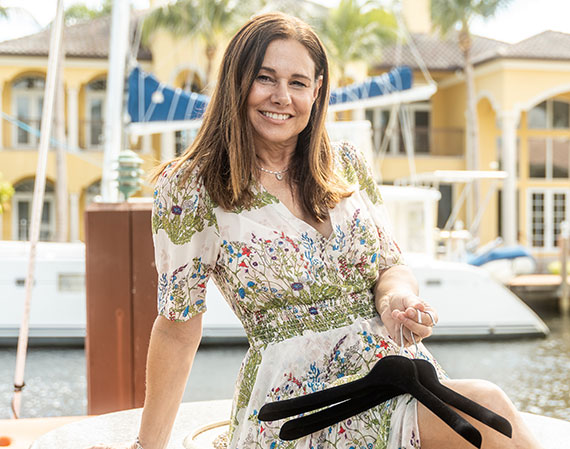
Donna Zalter is a Fort Lauderdale–based luxury real estate professional and founder of All Hung Up Hangers, a boutique hanger brand focused on durable, stylish closet solutions. After years of walking through high-end South Florida homes and seeing beautiful closets filled with cheap, flimsy hangers, she decided to merge her family’s hanger manufacturing background with her eye for design and launch a curated line of premium hangers.
As a Certified Luxury Home Marketing Specialist and experienced Realtor, Donna understands how small details like closet organization can affect both daily living and property value in competitive markets like Fort Lauderdale, Hallandale Beach and Sunny Isles. Today she splits her time between representing buyers and sellers with Compass Florida and growing All Hung Up Hangers from her base on Las Olas.